It never claims to be a real person.
On any path, it does not claim to be a real person, and it never claims to be the family member whose face and voice it uses. No setting changes that.

A FACE THEY CAN SEEBeta
KindredMind Presence™ is a companion on a tablet, in the room where they spend their day. A face they can see as well as a voice they can hear, for conversation and company whenever they want it.
It is designed around person-centered care: the person chooses whether to engage, and the conversation is shaped around their interests, pace, and preferences.
Not a video call. Nobody has to be free for it to happen.
Nothing for them to set up. Cancel any time.
Your 14-day trial includes up to 30 minutes of conversation and one voice. No card needed.
TWO PEOPLE, TWO CONVERSATIONS
Who it is for changes how it speaks. Choose the Mild Cognitive Impairment model or the Dementia model during setup, and change it later if their needs change.
EARLY MEMORY CHANGES
Contact with other people starts thinning out before a diagnosis is ever made. In a study following more than four thousand older adults, both face to face and telephone contact were already declining in the years before diagnosis, and declined further in the two years after.
Hackett et al., PLOS ONE, 2019
They still run their own day, and the companion speaks to them that way. Open questions, real opinions, subjects they choose. It talks about interests, family, routines, what they did yesterday and what they think about it. It does not simplify, slow down, or explain things they already know.
They start a conversation whenever they want one. There is no call to place and nobody to wait for.
EARLY MEMORY CHANGES
DOROTHY · PHOTOREAL
RICHARD · PHOTOREAL
MARIE · DRAWN
These examples use the Mild Cognitive Impairment model. Browse the current friendly face collection below.
Friendly faces are available with both the Mild Cognitive Impairment and Dementia models. A familiar face based on a family member is available only with the Dementia model.
There is no family face on this path, on purpose. Someone who still runs their own day does not need a digital version of their daughter.
DEMENTIA SUPPORT
More than four in ten people living with dementia report feeling lonely.
Hajek and Konig, BJPsych Open, 2025
Shorter sentences, unhurried pacing, and straightforward questions. When a subject turns confusing or upsetting it moves gently to something else rather than correcting them. It talks about family, routines, music, and the things they have always liked.
DEMENTIA SUPPORT
DOROTHY · PHOTOREAL
RICHARD · PHOTOREAL
MARIE · DRAWN
These examples use the Dementia model. Browse the current friendly face collection below.
Friendly faces are available with both the Mild Cognitive Impairment and Dementia models. A familiar face based on a family member is available only with the Dementia model.
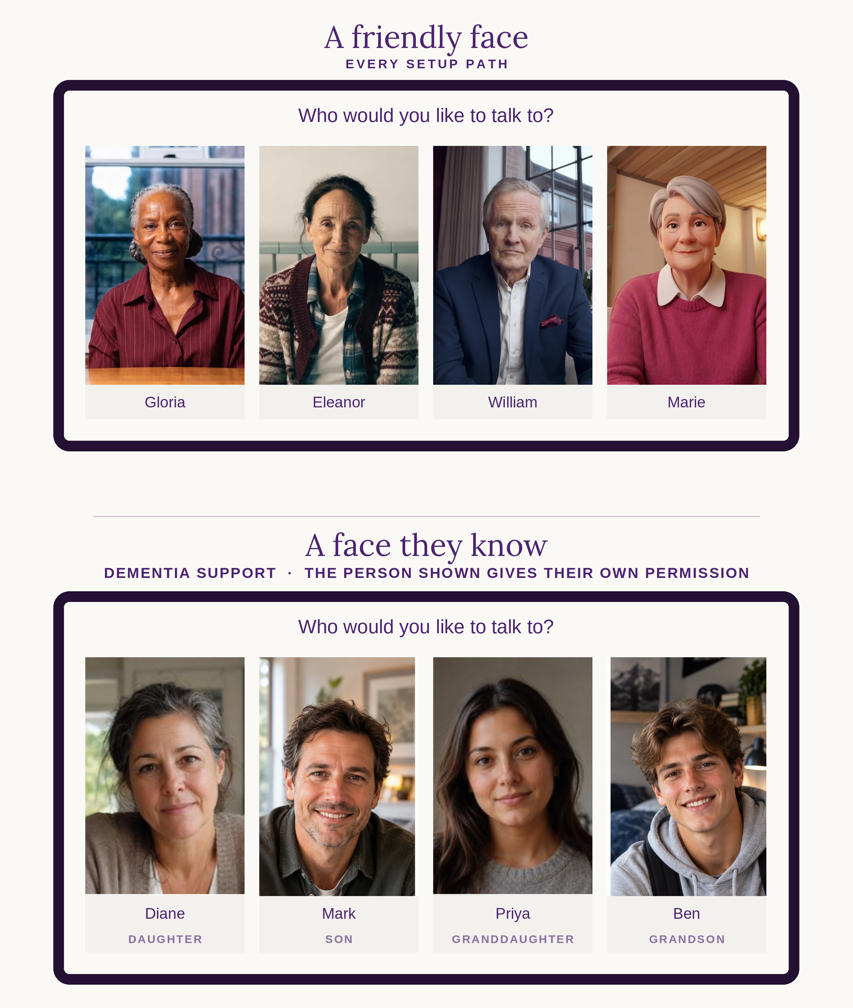
Thirty-three photoreal and three drawn. Friendly avatars work on both paths. Open the gallery and tap an avatar to hear a sample.
Show up to four faces at a time on the tablet, whether friendly avatars or familiar faces. The admin caregiver chooses which faces appear and can rotate the selection whenever they wish.
Familiar faces are for dementia support and require the person shown to give their own permission.
Choose from 36 ready made friendly avatars and start. No photograph, no voice recording, and nobody else to involve. Preview the faces and voices and pick the one that suits them.
A family member can choose to become the companion's face and voice. They give their own permission, provide their own photo, and record their own short voice sample.
A daughter, a son, a grandson or granddaughter. Anyone they would be glad to see.
Choose the face they are most likely to know today. Memory often keeps older faces longest, so a son or daughter can be a surer choice than a grandchild.
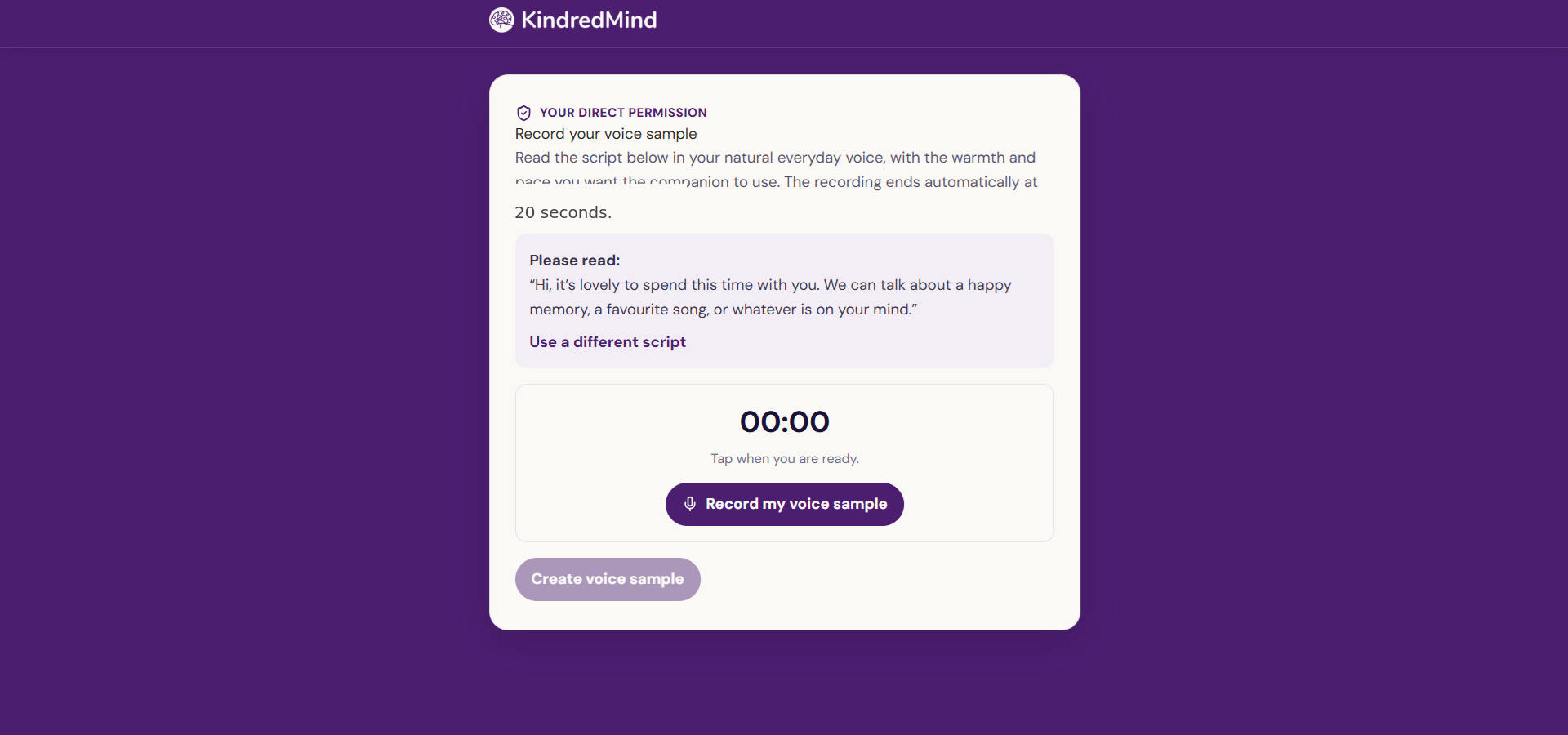
Twenty seconds of their voice and one photograph. They record it themselves.
“Had it existed while I was caring for my own mother, hearing my voice, even when I could not physically be there, would have brought her real comfort.”
Carol Jacobs
Gerontologist and Certified Dementia Practitioner
Professor, Gerontology Institute, Georgia State University
A FACE THEY KNOW
Everyone who gives their face and voice must be 18 or older. A photograph and a 20-second voice recording are required for familiar dementia Presence. The invitation cannot be completed without confirming permission.
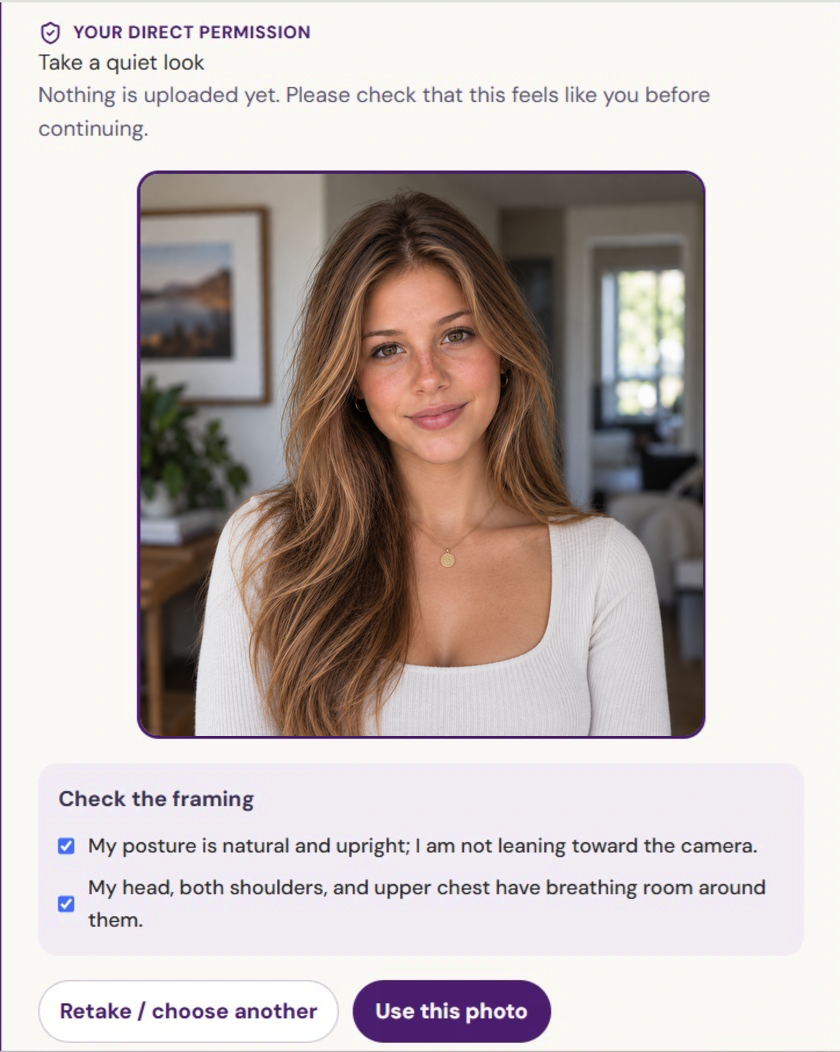
A photograph taken on their own phone.
Twenty seconds of their voice, recorded by them.
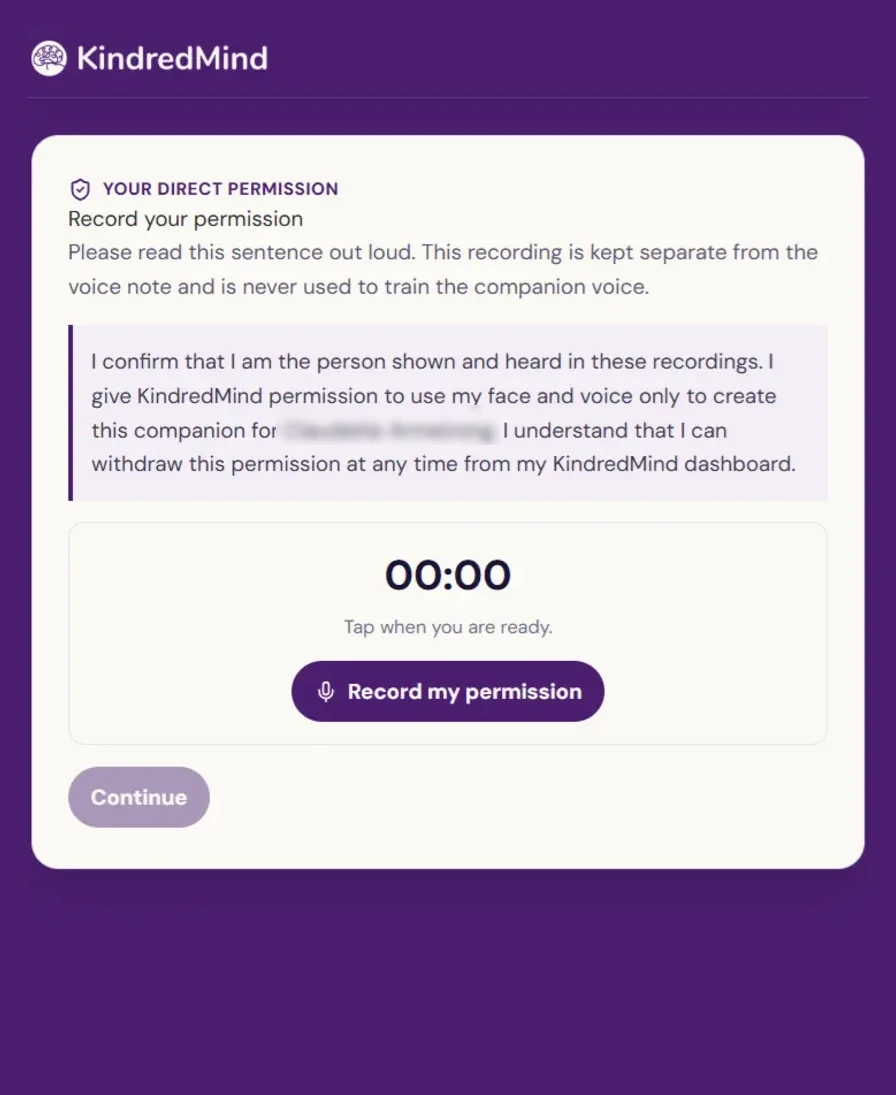
Their permission, recorded in their own voice.
Preview their face and voice together.
Emotional responses to a person can persist even when the ability to recall facts about them has gone.
Klein-Koerkamp, Baciu and Hot, Frontiers in Psychology, 2012
Every familiar face is created through a private, direct consent process. The person being represented decides whether their likeness can be used, and can withdraw that permission at any time.
“A familiar voice reaches one's emotional memory, which the disease spares long after names and dates have gone, and meeting a frightened person with reassurance rather than correction is what those of us trained in validation and simulated presence have long understood.”
Shadee Giurgius, M.D.
Adult and Geriatric Psychiatrist
Clinical Advisor, KindredMind
On any path, it does not claim to be a real person, and it never claims to be the family member whose face and voice it uses. No setting changes that.
A screen cannot make sure a pill is taken. That is what KindredMind Voice and KindredMind Reminders are for.
KindredMind does not diagnose, treat, or monitor anyone, it cannot call for help, and it makes no claim to affect memory or cognition.
No medical advice
It does not diagnose, recommend treatment, or discuss medication.
No money
It does not discuss banking, payments, investments, or transfers.
No credentials
It never asks for a password, a card number, or a one-time code.
No politics
It does not raise politics or contested social subjects, and it does not take sides when they come up.
No slurs or profanity
It does not use discriminatory language, including sexist language.
No comment on appearance
It does not remark on anyone's body, weight, or looks.
Adults only
Anyone giving their face and voice must be 18 or older.
It is never a real person
On any path it never claims to be human, and where it uses a family member's face and voice it never claims to be that person. There is no setting that turns this off.
These are instructions the companion follows, not locks on a door. It is AI. So on the one that matters most, we check again afterward: if a conversation turns to money, we look for it after the call and tell you.
The invitation goes to them, not to you. They record their own permission, in their own voice, saying who they are and what they are agreeing to.
An unfinished invitation expires after thirty days.
They can withdraw permission at any time. The face stops being available for new conversations, any conversation in progress ends, and the source photograph and recording are removed.
The tablet is always ready. They start a conversation themselves, with nothing to unlock and no call to place. You can add a weekly routine if it helps, and a routine never stops them starting one of their own.

LANGUAGES
Choose the language that feels most natural for their conversations.
WHAT YOU NEED
KindredMind Presence runs on a tablet you already have, or one you buy for them. It is not a device we ship and not a device you rent. The subscription is the companion, not the hardware.
You set it up once, from wherever you are. There is nothing for them to install, open, or sign into.
Recent conversation summaries, the schedule, the knowledge you have approved, and the minutes used this month against your plan.

A friendly face works on both paths. A face they know is for dementia support only.
| A friendly face | A face they know | |
|---|---|---|
| Ready to use today | Yes | After consent and setup |
| Based on a real family member | No | Yes |
| Needs a photo and voice sample | No | Yes, given by that person |
| Available for early memory changes | Yes | No |
| Available for dementia support | Yes | Yes |
| Faces displayed at a time on the tablet | Up to four | Up to four |
| Who chooses and rotates the displayed faces | The admin caregiver, whenever they wish | The admin caregiver, whenever they wish |
Care Expert Review
Assessed by Jeanette Yates against the Trusted Care Technology Framework
“A familiar voice reaches one's emotional memory, which the disease spares long after names and dates have gone, and meeting a frightened person with reassurance rather than correction is what those of us trained in validation and simulated presence have long understood.”
Shadee Giurgius, M.D.
Adult and Geriatric Psychiatrist
Clinical Advisor, KindredMind
“It would have given him comfort while giving me back the emotional bandwidth to simply be his daughter.”
Jennifer Fink
Caregiving Strategist and Host, Dementia Decoded
Most tools built for this ask the person to operate them. An app to open, a button to find, a call to accept before anyone appears.
KindredMind Presence asks nothing of her. The face is simply there when it is time. She does not tap, unlock, log in, or get it wrong in front of anyone.
She is spoken to the way she has been spoken to her whole life. No singsong, no quizzing, no explaining her own house to her.
There is nothing to learn and nothing to remember. Being handed technology you cannot work is its own small humiliation, and it happens to people with memory changes constantly.
She is not told again that he died. The Validation Method meets the feeling rather than the fact.
We will not tell you the companion never fibs. It meets her where she is, and sometimes that means agreeing that yes, it is her daughter on the phone. What we will tell you is what it never does: it never hurries her, never quizzes her, never talks down to her, and never treats her as a problem to be solved.
The principles behind this$159
USD / month
$219 CAD
300 conversation minutes a month
For one caregiver, with room for a conversation every day.
Your 14-day trial includes up to 30 minutes of conversation and one voice. No card needed.
Most popular
$219
USD / month
$299 CAD
450 conversation minutes a month
More time to talk, plus Conversation Insights and Auto-Schedule.
Conversation Insights: what they talked about and how it changed.
Your 14-day trial includes up to 30 minutes of conversation and one voice. No card needed.
$279
USD / month
$379 CAD
600 conversation minutes a month
The most time to talk, plus month over month trends.
Month over month trends across the whole account.
Your 14-day trial includes up to 30 minutes of conversation and one voice. No card needed.
No card required. Cancel any time.
No. You supply the tablet one they already have, or one you buy for them. The subscription covers the companion, not the hardware. Use a current base-model iPad with 64 GB running current Safari or Chrome, or a 10 to 11 inch Android tablet on Android 12 or later with 6 to 8 GB of RAM running current Chrome. You set it up once yourself; there is nothing for them to install or sign into.
No. The companion is on the screen when they look at it. There is nothing to open, no password, and no call to answer.
No. Nobody has to be free for it to happen, and you are not on the other end.
No. It never claims to be a real person, and where it uses a family member's face and voice it never claims to be that person.
Yes. The person represented can withdraw permission at any time, and their likeness stops being available for new conversations.
You see summaries. Full conversations are not laid out for browsing, and reading one is a deliberate step you have to take.
No. KindredMind cannot call for help and does not monitor anyone. In an emergency, call your local emergency number.
Dignity is a design principle, not a guaranteed outcome. KindredMind aims for warm, respectful conversation; misunderstandings and responses still require caregiver attention. Validation-oriented principles and Alzheimer Society of Canada communication guidance inform the design; this does not establish perfect adherence or a particular emotional effect. Nothing she can still do is taken away from her.
PRIVATE BY DESIGN
Everything you write about them is encrypted with AES-256 where it is stored, and protected with TLS while it travels. The key is held in a separate secrets manager, apart from the data it opens.
No identifying documents, no medical records, no financial information. Standard setup does not ask for a full legal name or a date of birth.
KindredMind does not diagnose, treat, or monitor anyone, and it makes no claim to affect memory or cognition.
Nothing for them to set up. Cancel any time.
Your 14-day trial includes up to 30 minutes of conversation and one voice. No card needed.